Bonsecours
tramway de Rouen
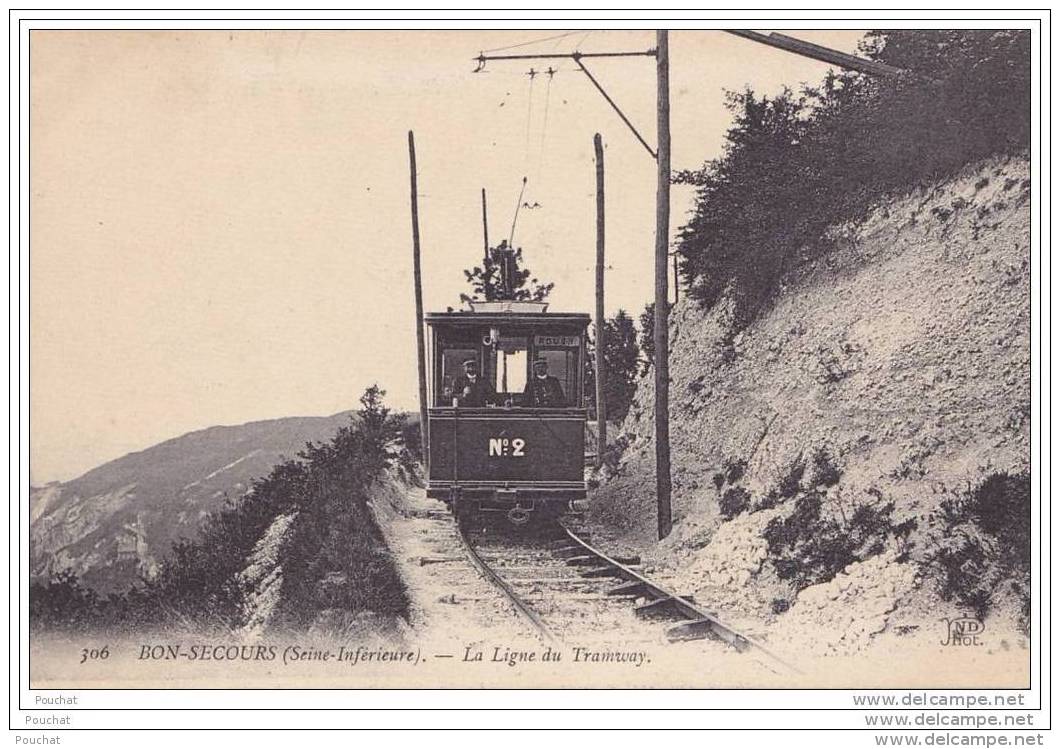 At first, in 1899, the tramway was designed to be steam powered, but by 1895 this had changed to electromotive power. The line was built by the Compagnie du Tramway de Bonsecours (CTB), and first ran on 21 May 1899.[39] It was 5,600 m (280 chains) between the two termini (the Pont Corneille and the crossroads of the RN 14 and the Belbeuf roads), with timetabling of up to 7 trams. The trams had greater power than their Rouen counterparts, with 38 hp (28 kW) motors. They could climb steep gradients (up to 9:100) and could accommodate 48 passengers, with 42 more in a trailing car.[40]
New ownership and closure
The Bon-Secours tramway on the coast. At the summit, the monument to Joan of Arc Seventy-two daily journeys each way brought the tramway success, and it transported nearly 700,000 passengers in 1901, compared to 140,000 for the funicular, which was clearly in a dire state financially (210,000 passengers in 1898).[39] The figures were so catastrophic that on 25 November 1905 the CTB sacked the management of the mountain railway, and liquidated the defunct Chemin Funiculaire d’intérêt local de Rouen-Eauplet au plateau de Bonsecours. Operations continued, and the CTR took over both tracks on 25 December 1909.[39] Although the tramway was always well used (900,000 tickets sold in 1913), the clientele of the funicular continued to fall (30,000 tickets collected the same year), and some daily receipts were less than 1 franc.[39] Lacking passengers, the funicular closed on 25 May 1915,[14] and the tramway became the monopoly service for Bonsecours. This date should not be confused with that for the Rouen service, which continued until February 1953.[24]